
*All product images and specifications are for reference only. Actual products may vary.

Automated Digital PCR System | ZY/VD-200 | Yuanzan
Product introduction
The Yuanzan ZY/VD-200 Series is an automated digital PCR (dPCR) system designed for sensitive nucleic acid quantification, molecular biology research, and advanced PCR applications. The VD-200A configuration supports up to 48 samples per run, with at least 20,000 droplets per sample under the specified operating conditions and up to six fluorescence detection channels.
Features
- Macro-Fluidic Droplet Generation (Macro-FDG) patented next-generation digital PCR platform
- Fully automated digital PCR system (Model VD-200A)
- Sample capacity: 48 samples per run
- Reaction volume: 20 µL (standard SOP)
- Droplet count: ≥ 20,000 per sample, ≥ 95% effective
- Droplet volume: 0.6 nL, CV < 5%
- Detection sensitivity: ≤ 0.01%, single-copy detection
- Dynamic range: 6 orders of magnitude, R ≥ 0.98
- Fluorescence channels: Up to 6 channels (FAM, HEX, Cy5, etc.)
- Light source: High-power white LED (450-750 nm), maintenance-free
- Detector: CMOS camera (500-800 nm)
- Thermal control: Semiconductor thermoelectric module
- Temperature range: 4.0°C – 99.0°C
- Temperature accuracy: ≤ 0.5°C
- Temperature uniformity: ≤ 1.0°C
- Average heating rate: ≥ 3°C/s
- Average cooling rate: ≥ 2°C/s
- 17.3" capacitive touchscreen
- Power input: AC 220V, 50/60 Hz
- Max power: < 2000 VA
- Operating system: Windows 10+
- Data export: Excel, XML
- Service life: 5 years
- Consumable type: Standard pipette tips
- Low consumable cost: ~$0.50 per run
- PZT-driven pinch-off droplet generation technology
- Compatible with standard tips (0.3-0.6mm)
- Multiple application scenarios including multiplex mutation detection (KRAS/BRAF mutation typing with melting curve analysis)
- Product configuration includes: Fully Automatic Digital PCR System, System Operation Software, Data Analysis Software, User Manual, and Dedicated Laboratory Instrument Case
Details


Explore Yuanzan's ZY/VD-200 digital PCR system
Digital PCR has long been powerful but expensive, locked into proprietary consumables, and limited to low-throughput use. Yuanzan changes this with a completely different technology lineage.
- Low cost barrier:Using standard-tip-scale consumables, per-sample consumable cost can drop by 20-40x compared with conventional dPCR workflows.
- High sample throughput:A 48-sample run format brings dPCR into routine laboratory schedules instead of one-off specialist operation.
- Open platform:No proprietary chips, no locked reagents, and no forced service contracts.
- From affordability question to routine use——When consumable cost drops by 20-40x per sample, the economic barrier to absolute quantification disappears.
- From specialized to routine——With 48-sample throughput and walk-away automation, dPCR becomes a practical daily lab tool.
- From closed ecosystem to open platform——The workflow avoids proprietary chips, locked reagents, and forced service contracts.
- From fragile to robust——Millimeter-scale channels are physically resistant to clogging with challenging clinical samples.
The Game Changer.
Digital PCR has long been a premium technology: powerful, but costly, tied to proprietary consumables, and limited by low throughput. Yuanzan changes that fundamentally.
- 0.01% Detection sensitivity
- ≥95% Valid droplets per sample
- 48 Max samples per run
Patent Nos.:ZL2021113351171 · ZL2021113351133 · ZL2021227610374 · ZL2021100379520
Industry-Leading Equipment Technology
Fully Automated Microdroplet Generation
World's first macro-fluidic microdroplet technology utilizing standard pipette tips to generate nanoliter-scale droplets, fundamentally reducing consumable costs while enhancing operational stability. Patent portfolio established (CN: 2021113351171, 2021113351133, 2021227610374, 2021100379520).
Core Technology Breakthrough
Traditional digital PCR requires microfluidic channels below 100 microns, resulting in prohibitive manufacturing costs. We are the world's first to break through microfluidic limitations—our macro-fluidic microdroplet technology generates nanoliter-scale droplets using standard pipette tips (>0.3mm diameter). This paradigm shift redefines cost-effectiveness in digital PCR.
Technical Advantages
- Dramatically reduces consumable manufacturing costs
- Accelerates liquid handling throughput
- Enhances instrument and droplet generation stability
- Facilitates massively parallel droplet generation architecture
- Seamless integration of macro-fluidic technology with automation delivers near-zero consumable costs and complete workflow automation
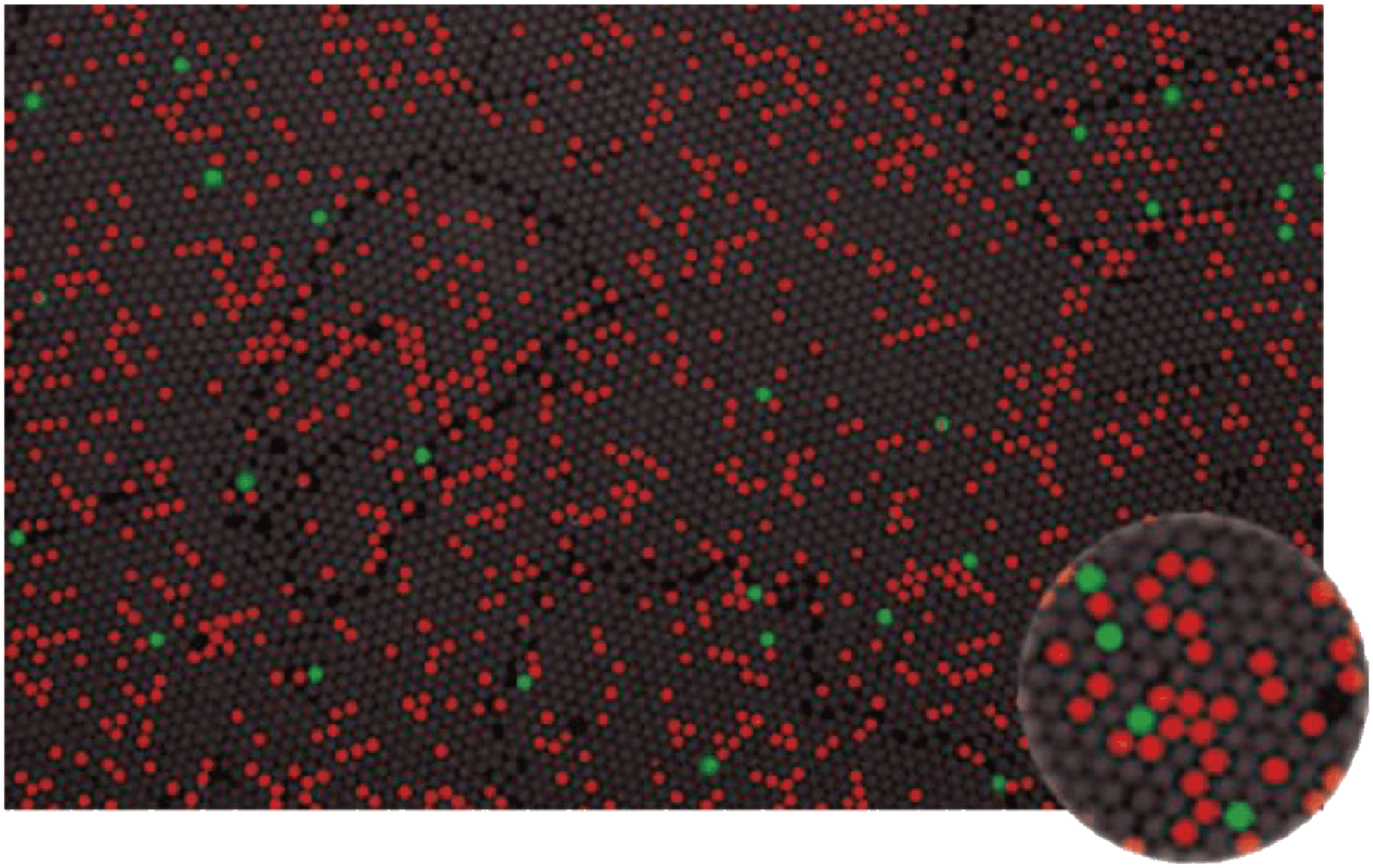
Self-Assembling Droplet Array
Our proprietary surfactant chemistry enables droplets to spontaneously self-assemble into ordered arrays on the reaction plate surface, maintaining structural integrity and preventing coalescence or evaporation during high-temperature thermal cycling.
Technical Principle
Leveraging our proprietary surfactant formulation, generated droplets maintain exceptional stability without coalescence even under high-temperature thermal cycling conditions. The precisely engineered droplet density exceeds that of the oil carrier phase, enabling gravity-driven self-assembly. Millions of droplets spontaneously organize across the PCR reaction vessel floor, forming a uniform, high-density droplet array.
Application Value
Spatial isolation of individual droplets is critical for ensuring uniform, independent reactions throughout the PCR vessel. This self-assembled droplet array architecture is essential for enabling in-situ PCR amplification and in-situ fluorescence detection, providing the foundation for independent single-droplet monitoring in real-time fluorescence PCR applications.
Massive-Scale Real-Time Droplet Fluorescence Monitoring
Simultaneous real-time tracking of fluorescence amplification signals from hundreds of thousands of individual droplets, eliminating false-positive artifacts while achieving true absolute quantification without reliance on Poisson statistics.
Technical Breakthrough
Building upon our self-assembling droplet array platform, our R&D team engineered proprietary optical signal collection pathways, advanced imaging modules, and sophisticated massive-scale droplet trajectory tracking algorithms. This integrated system enables continuous, real-time monitoring of fluorescence signals from each individual droplet throughout the entire PCR thermal cycling process.
Application Value
- Eliminates false-positive artifacts in clinical digital PCR applications
- Overcomes Poisson distribution limitations inherent in conventional digital PCR quantification of high-concentration samples
- Enables direct enumeration of copy numbers within each positive droplet, achieving true absolute quantification
- Unlocks novel applications through melting curve analysis capabilities previously unattainable with standard digital PCR technology
Core Features of Digital PCR
Macro-FDG droplet generation combines acoustic transmission, active recoil, adaptive impedance compensation, and waveform-shaped Weber number control. Together they stabilize droplet formation and create dense, uniform arrays for digital PCR imaging.
- Acoustic coupling:Near-rigid pressure-wave transmission moves through the drive oil with microsecond-scale delay, giving the nozzle a fast and repeatable actuation signal.
- Active recoil:A reverse acoustic wave sharpens droplet break-off and suppresses satellite droplets, improving the consistency of each partition.
- Variable impedance compensation:Adaptive frequency and voltage control keep the jetting state stable as the fluid load changes during droplet generation.
- Weber number control:Waveform shaping controls dV/dt so droplet size remains stable and less dependent on small variations in tip geometry.
A completely different technology lineage
Macro-FDG is not an iteration of existing dPCR systems. It uses an active acoustic jetting principle built around standard-scale tips.
- Channel / nozzle:Micro-well Micro-wells (pL) · Microfluidic Micro-channels (<0.1 mm) · Macro-FDG Standard tips (0.3-0.6 mm)
- Droplet generation:Micro-well Passive partitioning · Microfluidic Oil shear at junction · Macro-FDG Active acoustic jetting + recoil
- Sample throughput:Micro-well 16/run · Microfluidic 8-24/run · Macro-FDG 48/run
- Consumable cost/run:Micro-well ~$15-30 · Microfluidic ~$10-20 · Macro-FDG ~$0.50
- Scalability:Micro-well Fixed chip design · Microfluidic Complex micro-fabrication · Macro-FDG Linear scaling, simple manufacturing
Equipment Has Wide Applications
Widely applied in clinical diagnosis and research fields
Clinical Applications
Genetic testing provides individual patient variation information at the molecular level, offering driver gene mutation analysis for cancer treatment and significantly enhancing the safety and efficacy of targeted therapeutics.
- Cancer Genetic Testing
- Viral Load Detection
- Prenatal Testing
Limitations of Traditional Medicine
Traditional medical approaches face substantial limitations in treating many cancers (including lung, colorectal, and gastric cancers). Genetic testing delivers molecular-level insights into individual patient variations and provides driver gene mutation analysis for cancer treatment, thereby dramatically improving the safety and efficacy of targeted therapeutics.
Advantages of Digital PCR Detection
Polymerase Chain Reaction (PCR) is a detection technology capable of rapidly amplifying specific genes in vitro. The latest third-generation digital PCR technology partitions samples into numerous micro-reaction chambers for single-copy amplification and fluorescence enumeration, achieving single-molecule resolution quantification of nucleic acids. Compared to conventional quantitative PCR, it delivers superior quantification precision, sensitivity, and interference resistance. Additionally, this technology demonstrates exceptional clinical advantages in viral load detection and prenatal testing applications.
Challenges We Address
Digital PCR adoption in research and clinical settings faces two critical challenges: equipment and consumable costs, and the limitation that current commercial systems employ endpoint detection rather than real-time monitoring, significantly constraining clinical assay development. Our pioneering self-assembling droplet array digital PCR eliminates the need for complex, expensive consumables while enabling massive-scale real-time fluorescence monitoring. This breakthrough ushers digital PCR into the real-time monitoring era, accelerating its entry into the blue ocean clinical genetic testing market.
Non-Clinical Applications
Provides more reliable molecular detection methods in research laboratories, food safety inspection, and forensic investigation.
- Molecular Biology Laboratory Research
- Genetically Modified Food Inspection
- Criminal Investigation and Forensic Identification
Genetic Analysis in Molecular Biology Laboratories
PCR technology is so ubiquitous in daily research that it's difficult to imagine a molecular biology laboratory without PCR equipment. While digital PCR offers numerous advantages over traditional PCR, significant gaps remain in user experience and consumable costs. Our next-generation digital PCR products will deliver a user experience indistinguishable from conventional quantitative PCR. As digital PCR equipment and consumable costs continue to decline, our products are positioned for adoption by laboratories of all scales.
Genetically Modified Food Inspection
Public attention to genetically modified foods continues to intensify. Currently, real-time quantitative PCR is commonly employed for molecular quantification of GMO content in commercial products. However, in complex food ingredients and feed raw materials where target DNA is extremely scarce, detection and quantification face significant constraints. Research demonstrates that digital PCR delivers superior repeatability for low-concentration detection and enhanced tolerance to inhibitors, providing a novel, more reliable inspection methodology for genetically modified food testing.
Criminal Investigation
In criminal investigation and public security management, PCR technology occupies an increasingly critical position due to advances in genetic engineering and forensic science, ushering investigation into the era of molecular evidence. Through digital PCR, identification can be achieved at the individual confirmation level. Its molecular-level confirmation of forensic evidence—including bloodstains, semen stains, hair, tissue fragments, and even trace residual cells—proves far more reliable than previous serological methods. Moreover, leveraging exceptional amplification efficiency and robust interference resistance, digital PCR enables analysis of minimal trace evidence exposed over extended periods, facilitating individual identification. Modern forensic identification for individual discrimination is inseparable from PCR technology.
Comprehensive after-sales support.
From installation and training to maintenance, assay optimization, and custom reporting, our support system keeps instrument deployment practical after purchase.
- Regular customer visit and feedback program
- Responsive customer service system
- Efficient maintenance and spare parts network
- 24-hour technical support hotline
- Installation and training by factory engineers
- Customized assay optimization for specific kits
- Software customization services
- Custom report format design
The following is an overview of our after-sales service coverage. Specific service details may vary by product. Contact us for more information.