
PRODUCT
How Reliable Manual Pipettes Are Manufactured: ISO 8655 Accuracy, 200,000 Press Cycles, and Drop-Tested Durability
Learn how reliable manual pipettes are manufactured through precision molding, metal internal components, sealing systems, ISO 8655-based calibration, 200,000 press-cycle durability testing, and drop-tested accuracy for PCR, IVD, and routine laboratory workflows.
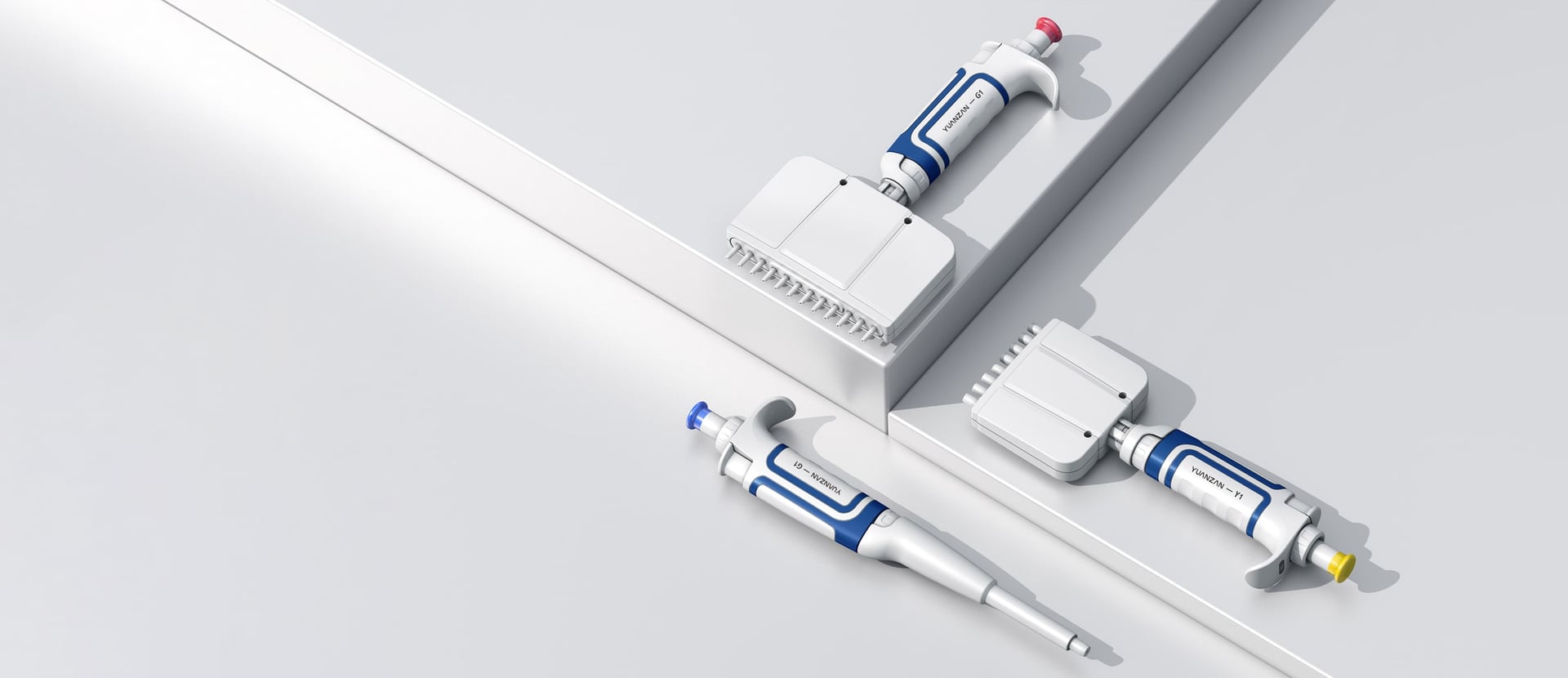
Manual pipettes look simple from the outside.
Press, aspirate, dispense, eject the tip.
But for PCR labs, IVD labs, molecular biology labs, teaching laboratories, routine testing facilities, distributors, and OEM/ODM buyers, a manual pipette is not just a small laboratory instrument.
It is a daily liquid handling tool that must remain accurate, stable, and comfortable after thousands of repeated operations.
That is why reliability should not only be judged by how a pipette performs when it leaves the factory.
A more important question is:
Can the pipette maintain accuracy, sealing performance, mechanical stability, and user comfort after long-term use, repeated pressing, and accidental drops?
For a reliable manual pipette, claims such as:
-
metal internal components designed for 200,000 press cycles
-
accuracy maintained after 5 drop events under defined validation conditions
-
ISO 8655-based accuracy and precision testing
-
stable sealing and smooth plunger movement
-
single-channel, 8-channel, and 12-channel configurations
-
compatibility with PCR, IVD, teaching, and routine laboratory workflows
are not isolated product features.
They are the result of a complete manufacturing and validation system.
1. A manual pipette is not only a plastic shell
From the outside, a manual pipette may look like a plastic handheld tool.
Inside, however, it is a precision mechanical system.
A reliable manual pipette usually includes:
| Component system | Function | Why it matters |
|---|---|---|
| Plunger system | Controls aspiration, dispensing, and blow-out | Affects user feel, repeatability, and workflow comfort |
| Piston system | Controls the movement of air volume | Directly affects accuracy and precision |
| Metal internal components | Support repeated pressing, transmission, and return movement | Affects durability and long-term mechanical stability |
| Spring system | Provides return force and smooth operation | Affects consistency after repeated use |
| Sealing system | Maintains air tightness | Affects leakage control, accuracy, and repeatability |
| Volume adjustment system | Sets and locks the selected volume | Affects reading stability and volume reliability |
| Tip connection system | Connects the pipette tip to the shaft | Affects sealing, tip compatibility, and ejection force |
This is why a manual pipette manufacturer cannot rely only on injection molding.
A reliable manual pipette is built through the integration of precision molded parts, metal components, sealing elements, mechanical assembly, calibration, and performance validation.
2. Reliable pipette manufacturing starts with design input
In international manual pipette manufacturing, the process usually begins before production.
It starts with design input.
A manufacturer needs to define:
| Design input | Key question |
|---|---|
| Volume range | Which ranges should be covered: 0.1–2 µL, 0.5–10 µL, 2–20 µL, 20–200 µL, 100–1000 µL, or multi-channel formats? |
| Application | Is the pipette designed for PCR, IVD, teaching labs, routine liquid handling, or plate-based workflows? |
| Accuracy target | What systematic and random error levels should be achieved? |
| Ergonomics | What level of pressing force and tip ejection force is acceptable for repeated daily use? |
| Tip compatibility | Should the product use a dedicated tip system or a universal conical tip interface? |
| Durability | How many press cycles should the internal mechanism withstand? |
| Drop resistance | Can the core liquid handling system remain stable after accidental drops? |
| Calibration method | How will the pipette be tested and adjusted before release? |
| Documentation | What technical documents, calibration reports, or OEM/ODM files should be available for buyers? |
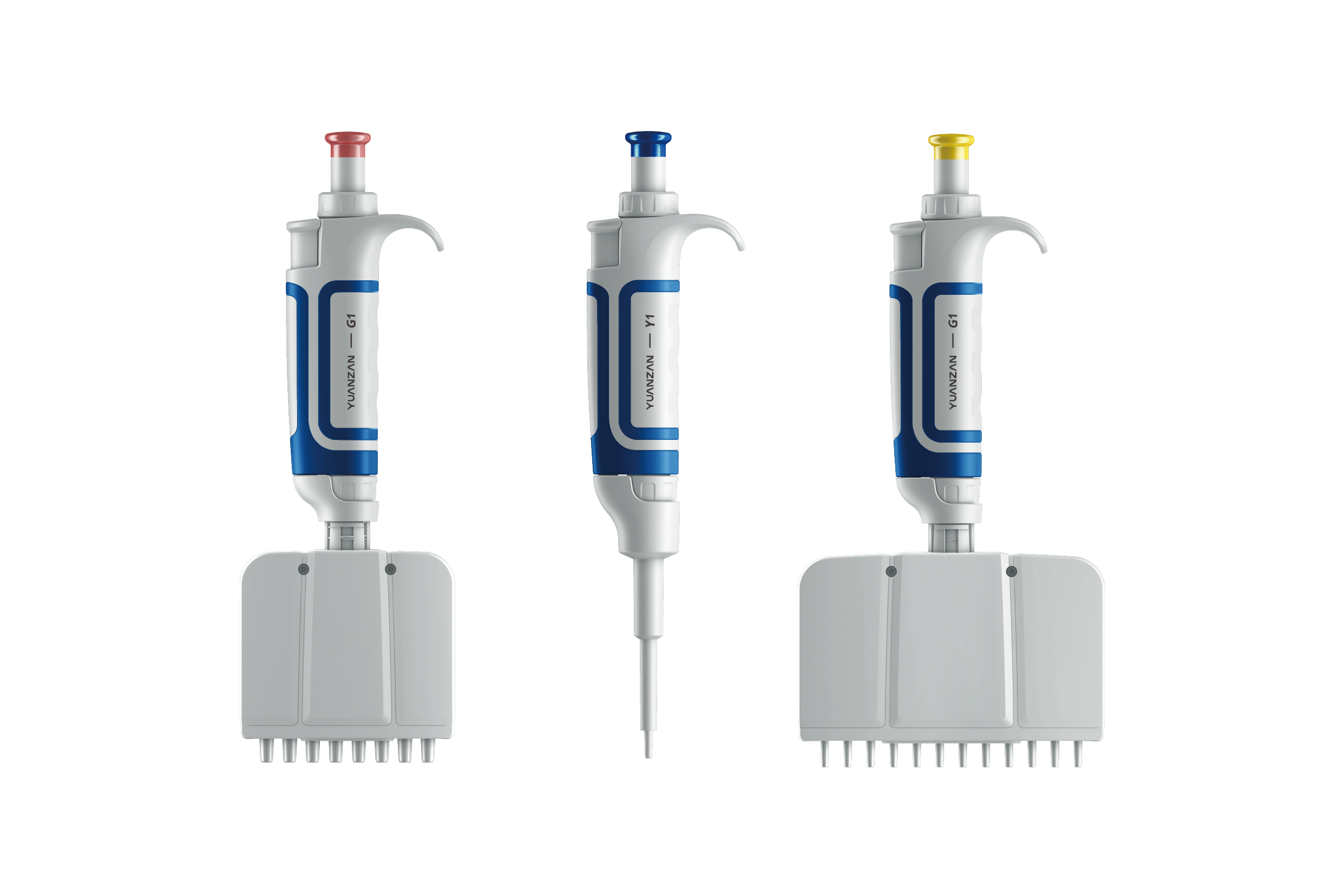
For Yuanzan Y1/G1 Manual Pipettes, two design directions are especially important:
| Series | Design direction | Practical value |
|---|---|---|
| Y1 Manual Pipette | Cylindrical shaft / tip system | Designed to reduce tip loading and ejection force |
| G1 Manual Pipette | Universal conical shaft / tip system | Designed for broader conventional pipette tip compatibility |
This gives laboratories and distributors different options depending on workflow habits, existing consumable systems, and procurement strategy.
3. Why metal internal components matter
A manual pipette is used through repeated mechanical movement.
Every day, the internal system may experience:
-
first-stop pressing
-
second-stop blow-out
-
spring return
-
volume adjustment
-
tip loading
-
tip ejection
-
repeated aspiration and dispensing
The internal metal components and spring system are responsible for maintaining mechanical stability during these cycles.
If the metal components deform, wear, loosen, or lose alignment, users may notice:
-
inconsistent plunger feel
-
unstable return movement
-
increased pressing resistance
-
volume drift
-
weaker sealing performance
-
reduced accuracy after repeated use
This is why a 200,000 press-cycle durability target is meaningful.
It is not just a number.
It reflects the long-term stability of the mechanical system.
For PCR labs and IVD labs, this matters because manual pipettes are not used occasionally.
They are used repeatedly in sample preparation, reagent transfer, dilution, PCR setup, qPCR plate preparation, and routine liquid handling.
4. Why drop testing matters for pipette accuracy
Accidental drops are common in laboratories.
A pipette may fall from the bench during sample handling, tip replacement, cleaning, or instrument transfer.
A drop can affect several areas:
| Drop risk | Potential impact |
|---|---|
| Shell deformation | May affect structural alignment |
| Piston misalignment | May affect aspiration and dispensing volume |
| Seal displacement | May cause leakage or poor repeatability |
| Volume adjustment shift | May affect set volume stability |
| Tip cone damage | May affect tip fitting and sealing |
| Internal component shock | May affect mechanical consistency |
That is why drop testing should not only ask:
Is the pipette broken?
A better question is:
Can the pipette still maintain accuracy after the drop event?
For a reliable manual pipette, drop resistance should be evaluated together with post-drop accuracy checks.
A pipette that looks intact but loses accuracy is still a risk for PCR, IVD, and routine laboratory workflows.
This is why “5 drops without loss of accuracy” is best understood as a structural and calibration-retention performance indicator.
It suggests that the pipette is designed to protect the core liquid handling mechanism from common accidental impacts under defined test conditions.
5. The manufacturing workflow behind a reliable manual pipette
A dependable manual pipette is usually produced through a controlled multi-step process.
| Manufacturing stage | Core task | Key quality control point |
|---|---|---|
| 1. Product design | Define volume range, shaft system, ergonomics, and accuracy target | Application fit and performance target |
| 2. Material selection | Select plastic, metal, spring, and sealing materials | Strength, fatigue resistance, wear resistance, chemical compatibility |
| 3. Precision molding | Produce shell, button, adjustment, and structural components | Dimensional stability, surface quality, tolerance control |
| 4. Metal component processing | Produce piston and internal transmission components | Straightness, surface finish, wear resistance |
| 5. Sealing system assembly | Install piston, sealing rings, and air-channel elements | Air tightness and sliding consistency |
| 6. Full instrument assembly | Combine shell, plunger, volume setting, piston, shaft, and ejection system | Assembly consistency and operation feel |
| 7. ISO 8655-based calibration | Test and adjust accuracy and precision | Systematic error and random error control |
| 8. Functional inspection | Check aspiration, dispensing, blow-out, tip ejection, and volume setting | Usability and sealing performance |
| 9. Durability testing | Validate press cycles, return force, and mechanical stability | Long-term use reliability |
| 10. Drop testing and re-check | Evaluate accuracy after accidental impact simulation | Structural integrity and calibration retention |
| 11. Final quality inspection | Inspect appearance, function, packaging, and documentation | Batch consistency and traceability |
This process shows why manual pipettes are not simple assembled products.
They are precision liquid handling instruments that require controlled manufacturing and validation.
6. ISO 8655-based calibration: why it matters
For international buyers, ISO 8655 is one of the most important reference frameworks for piston-operated volumetric apparatus, including manual pipettes.
In practical procurement, ISO 8655-based testing helps buyers evaluate:
-
systematic error
-
random error
-
test volume points
-
calibration method
-
environmental conditions
-
repeatability of measurement
-
documentation quality
For a manual pipette supplier, ISO 8655-based calibration is not only a technical claim.
It is a way to make accuracy and precision measurable.
For laboratories, this means the buyer can move from a subjective question:
Does this pipette feel good?
to a measurable question:
Does this pipette meet our accuracy and precision requirements under a recognized testing framework?
For distributors and OEM/ODM buyers, ISO 8655-based documentation can also support product evaluation, customer training, tender preparation, and after-sales communication.
7. Y1 and G1: two shaft systems for different procurement needs
Yuanzan Y1/G1 Manual Pipettes are designed with two different shaft and tip-system approaches.
Y1: cylindrical shaft / tip system
The Y1 design focuses on reducing tip loading and ejection force.
This can be useful for:
-
high-frequency pipetting
-
PCR and qPCR workflows
-
teaching labs with repeated student use
-
users who experience hand fatigue
-
plate-based liquid handling when used with multi-channel formats
Lower force is not only a comfort feature.
It can also improve daily workflow efficiency when users repeat pipetting actions hundreds of times.
G1: universal conical shaft / tip system
The G1 design focuses on broader compatibility with conventional conical pipette tips.
This can be useful for:
-
labs with existing pipette tip inventory
-
distributors selling into different consumable systems
-
users who want a lower switching barrier
-
procurement teams that need flexibility across multiple tip brands
For many labs, tip compatibility is a real cost factor.
Changing pipettes may also mean changing tips, inventory habits, purchasing workflows, and SOPs.
This is why a manual pipette supplier should not only talk about the instrument.
It should also talk about the complete liquid handling ecosystem.
8. Real-world scenario: PCR and IVD laboratory workflow
Consider a regional IVD laboratory running daily PCR sample preparation.
The lab may use:
-
0.5–10 µL pipettes for enzymes, primers, probes, and low-volume reagents
-
2–20 µL pipettes for PCR master mix components
-
20–200 µL pipettes for sample and buffer transfer
-
100–1000 µL pipettes for dilution and reagent preparation
-
8-channel or 12-channel pipettes for 96-well plate workflows
In this environment, the pipette must handle:
-
high-frequency pressing
-
repeated tip loading and ejection
-
accidental bench drops
-
multiple users
-
frequent cleaning
-
strict accuracy expectations
-
compatibility with the lab’s selected pipette tips
A reliable pipette is not only accurate on day one.
It should remain stable throughout daily use.
This is why durability, drop resistance, ISO 8655-based calibration, tip compatibility, and ergonomic design must be evaluated together.
9. What distributors should ask a manual pipette manufacturer
For distributors, a manual pipette is not only a laboratory tool.
It is part of a broader lab consumables portfolio.
Before selecting a manual pipette manufacturer, distributors should ask:
-
Are single-channel, 8-channel, and 12-channel pipettes available?
-
What volume ranges are covered?
-
Are accuracy and precision tested according to ISO 8655-based procedures?
-
Can calibration documentation be provided upon request?
-
What durability testing has been performed?
-
Has the pipette been evaluated after drop testing?
-
What pipette tips are compatible?
-
Are matching pipette tips available from the same supplier?
-
Can the supplier support OEM or ODM packaging?
-
Can the supplier provide product documentation for regional sales teams?
-
What is the replacement or warranty policy?
-
Can the supplier support broader life science consumables procurement?
For distributors, the best supplier is not only the one with a low unit price.
It is the supplier that can support:
product reliability + documentation + supply stability + portfolio expansion + commercial margin.
10. What OEM/ODM buyers should evaluate
For OEM/ODM manual pipette projects, buyers should evaluate both technical and commercial readiness.
| OEM/ODM requirement | Why it matters |
|---|---|
| Product structure options | Different markets may prefer low-force or universal-tip systems |
| Volume range coverage | A complete product family supports catalog expansion |
| ISO 8655-based validation | Helps support technical credibility |
| Calibration documentation | Helps support customer trust and tender communication |
| Packaging customization | Supports private label and distributor programs |
| Matching consumables | Pipettes, pipette tips, PCR tubes, and plates can be sold together |
| Quality consistency | Reduces after-sales burden |
| Supply capability | Supports long-term distributor relationships |
For a lab consumables manufacturer, manual pipettes can also become an entry point into a wider liquid handling and life science consumables portfolio.
This includes:
-
pipette tips
-
filter tips
-
PCR tubes
-
PCR plates
-
deep-well plates
-
cell culture consumables
-
cryogenic storage consumables
-
OEM/ODM lab consumables programs
A pipette is not only a product.
It can be part of a complete laboratory procurement solution.
11. Why manufacturing capability matters
A reliable manual pipette requires more than product design.
It also depends on manufacturing infrastructure.
For a lab consumables manufacturer, relevant capabilities may include:
-
precision injection molding
-
controlled production environment
-
component assembly
-
product inspection
-
batch consistency control
-
calibration workflow
-
packaging and documentation support
-
OEM/ODM customization capability
This is especially important for distributors and overseas buyers who need stable long-term supply.
A product may pass initial evaluation, but the supplier must also maintain consistency across batches.
That is why supplier selection should include both product testing and manufacturing assessment.
12. Practical validation workflow before bulk procurement
Before switching to a new manual pipette supplier, buyers can follow a simple validation process.
| Week | Validation task | Decision point |
|---|---|---|
| Week 1 | Receive samples and review documentation | Is the product ready for internal testing? |
| Week 2 | Test accuracy and precision using ISO 8655-based internal methods | Does it meet the lab’s acceptance criteria? |
| Week 3 | Test tip compatibility and leakage | Does it work with the lab’s selected tips? |
| Week 4 | Use in real PCR, IVD, teaching, or routine workflows | Does it fit daily use? |
| Week 5 | Review user feedback and procurement cost | Is it suitable for scale-up? |
| Week 6 | Confirm packaging, documentation, and supply terms | Is it ready for distributor or OEM/ODM procurement? |
This approach helps buyers avoid two mistakes:
-
buying only because the unit price is low
-
rejecting a cost-effective alternative before real validation
The right sequence is:
sample → test → validate → document → scale.
13. Conclusion: a reliable manual pipette is manufactured, tested, and validated
A reliable manual pipette is not created by one feature.
It is the result of a complete system:
-
mechanical design
-
material selection
-
metal internal components
-
precision molded parts
-
sealing structure
-
volume adjustment stability
-
ISO 8655-based calibration
-
durability testing
-
drop testing
-
final quality inspection
-
documentation support
Metal internal components designed for 200,000 press cycles indicate long-term mechanical stability.
Accuracy maintained after repeated drop events indicates structural protection and calibration retention.
ISO 8655-based testing helps make accuracy and precision measurable.
For PCR labs, IVD labs, teaching labs, routine testing facilities, distributors, and OEM/ODM buyers, the real question is not simply:
Which pipette is the cheapest?
The better question is:
Which manual pipette supplier can provide a validated, scalable, cost-effective liquid handling solution for real laboratory workflows?
That is the standard buyers should use when evaluating manual pipettes in 2026.
FAQ
1. What makes a manual pipette reliable?
A reliable manual pipette should maintain accuracy, precision, sealing performance, smooth operation, and tip compatibility after repeated daily use. Key factors include piston quality, metal internal components, sealing structure, ergonomic design, ISO 8655-based calibration, durability testing, and drop-tested stability.
2. Why is ISO 8655 important for manual pipettes?
ISO 8655 provides an internationally recognized reference framework for testing piston-operated volumetric apparatus, including manual pipettes. ISO 8655-based testing helps evaluate systematic error, random error, repeatability, and calibration reliability.
3. Why do metal internal components matter in manual pipettes?
Metal internal components support repeated pressing, spring return, transmission, and volume control. Their durability affects long-term mechanical stability, plunger feel, and accuracy retention after repeated use.
4. What does 200,000 press-cycle durability mean?
A 200,000 press-cycle durability target indicates that the pipette’s internal mechanical system is designed to withstand long-term repeated operation. It helps evaluate the stability of internal metal components, spring return, piston movement, and volume adjustment.
5. Why does drop testing matter for pipettes?
Pipettes may accidentally fall from laboratory benches. Drop testing helps evaluate whether the instrument can maintain structural integrity and accuracy after impact. A pipette that looks undamaged but loses accuracy can still create risk in PCR, IVD, and routine lab workflows.
6. What is the difference between Y1 and G1 manual pipettes?
Yuanzan Y1 uses a cylindrical shaft / tip system designed to reduce tip loading and ejection force. Yuanzan G1 uses a universal conical shaft / tip system designed for broader conventional pipette tip compatibility.
7. Who should evaluate Yuanzan Y1/G1 Manual Pipettes?
Yuanzan Y1/G1 Manual Pipettes can be evaluated by PCR labs, IVD labs, teaching labs, routine testing facilities, distributors, OEM/ODM buyers, and laboratory consumables suppliers looking for a cost-effective manual pipette solution.